


The Rt. Hon. Speaker of Parliament, Alban Sumana Kingsford Bagbin, has renewed calls for parliamentary decentralization, describing it as a critical reform needed to bring Parliament closer to the people and strengthen Ghana’s democratic governance.
Speaking at the Speaker’s Breakfast Forum held on Wednesday, March 4, 2026, at the Palms Hotel in Accra under the theme “Parliamentary Decentralization: Taking Parliament Closer to the People,” the Speaker said devolving aspects of parliamentary work to regional and local structures would ease the burden on Members of Parliament (MPs) while enhancing citizen participation.
Decentralization to Improve Responsiveness
According to Speaker Bagbin, decentralizing parliamentary functions such as community engagement, policy consultations, and oversight to locally based parliamentary offices would create more responsive and representative democratic institutions.
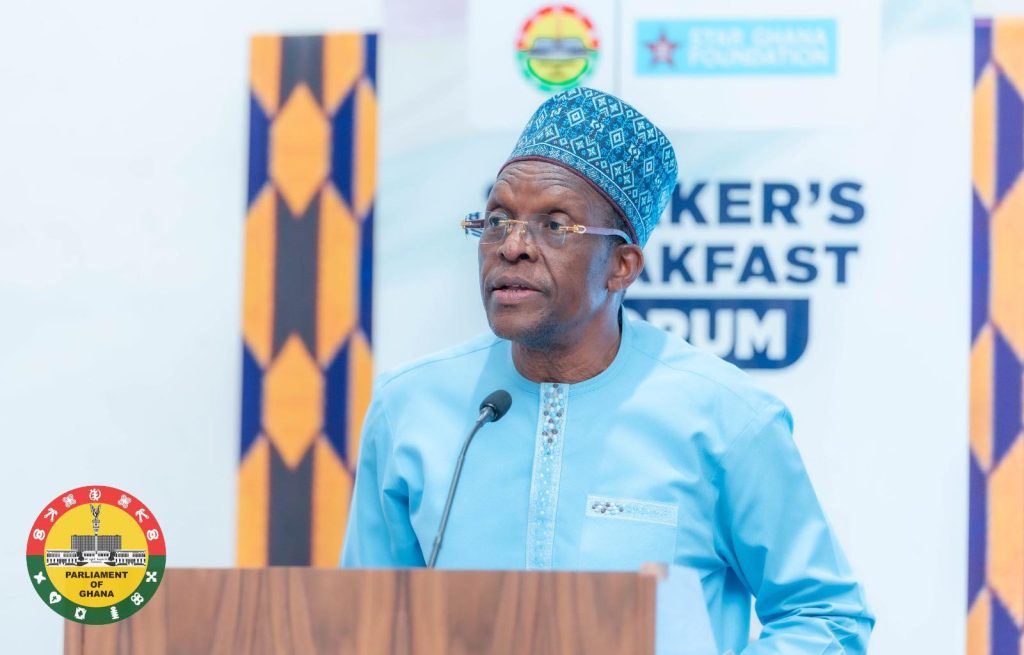
He explained that such reforms would help clarify the distinct roles of MPs, Assembly Members, local government officials, and development actors — a move he believes will realign citizen expectations and reduce public misunderstanding of parliamentary responsibilities.
“When legislative power is decentralized, oversight becomes more immediate, visible and tangible. Citizens can hold their local leaders directly accountable,” he stressed.
He further noted that decentralization would promote inclusivity by ensuring that all regions and communities, regardless of location, religion, language, gender or age, have a voice in parliamentary governance.
Partisanship Hindering Coordination
Governance experts and policy actors who contributed to the discussion pointed to weak coordination between Parliament and the District Assemblies as a major challenge.
Representing the Chamber for Local Governance, Dr. Richard Fiadomor observed that the cyclical collaboration expected between MPs and Assemblies has been misunderstood, leading to poor coordination and development misalignment.
He explained that MPs are members of the District Assemblies to channel local concerns to Parliament and communicate parliamentary decisions back to the Assemblies for policy alignment. However, excessive partisanship between MPs and Assembly members, he said, continues to widen the disconnect between the two governance levels.
Dr. Fiadomor proposed decentralizing the Office of the Parliamentary Service rather than merely establishing constituency offices for MPs. He also advocated empowering Presiding Members to represent the Speaker’s interest at the Assembly level to reinforce the separation of powers.
Reforming the Political Structure
The Founder of the Parliamentary Network Africa, Sammy Obeng, argued that the structure of parliamentary elections and campaign promises has distorted public perception of MPs’ constitutional roles. He called for Parliament to institutionalize citizens’ right to participate in parliamentary proceedings.
Former Local Government Minister, Prof. Kwamena Ahwoi, said the misconception of MPs as development agents dates back to pre-Fourth Republic political arrangements. He noted that Parliament’s decision to annex portions of the District Assemblies Common Fund further deepened this perception.
Prof. Ahwoi recommended an annual alignment conference between Regional Coordinating Councils and Regional Parliamentary Caucuses and suggested the establishment of a Local Government Office within the Parliamentary Service.
Calls for Election of MMDCEs
Veteran lawyer Sam Okudzeto called for District Chief Executives to be elected rather than appointed by the President, arguing that this would enhance accountability at the local level.
Supporting this position, the Chairperson of the National Commission for Civic Education, Kathleen Addy, described the election of Metropolitan, Municipal and District Chief Executives (MMDCEs) as a major step toward deepening decentralization.
Administrative Reforms Underway
The Second Deputy Speaker, Andrew Asiamah Amoako, suggested that Assembly meetings be scheduled during parliamentary recess periods to enable MPs to actively participate.
He also disclosed that Parliament has made arrangements to establish administrative offices for MPs in their constituencies beginning this year — a move seen as a significant step toward operationalizing parliamentary decentralization.
The forum concluded with a strong consensus that deepening decentralization requires structural reforms, civic education, and bipartisan cooperation to strengthen accountability and bring governance closer to the people.
Source: Clement Akoloh||parliamentnews360.com


